
Treadle Drill
Treadle Drill
Catalogue No. 081
by Ottilie Drown
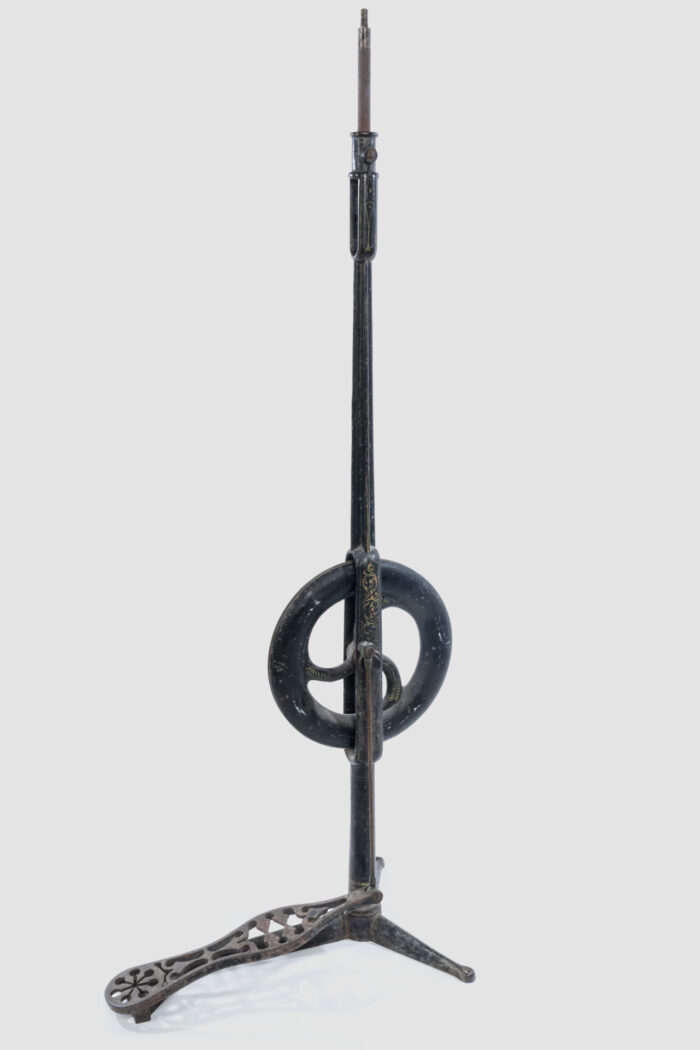
Treadle Drill (Catalogue Number: 081)
This item is part of a Victorian treadle drill, which would have been used to remove tooth decay or diseased tissue from the teeth. While the item in this collection is estimated to date from around 1890, this type of drill was originally designed in 1871 by James Beall Morrison (who is also credited with designing the adjustable chair that allowed for sit-down dentistry!) By the late nineteenth century, the dental profession was becoming more formalised, with increasing emphasis on professional training and modern equipment. Instruments such as Morrison’s treadle drill represented a significant improvement to earlier hand-cranked drills.
What is seen here, however, is only part of the drill Morrison designed. A complete treadle drill would have a rubber tube with a drill on its end on top of the upright pole - our example has grooves this attachment would screw onto. The dentist would pump the foot pedal, which would turn the wheel, and the energy this produced would power the drill. The pedal would have taken significant effort to push down, and the holes in the drill’s base suggest it would have been screwed into the floor for security. Being operated by a foot pedal, the treadle drill allowed procedures to be performed more quickly and less painfully, while also enabling dentists to carry out more complex treatments. The treadle drill is constructed from cast iron, with elements of steel and brass. The choice of durable metals ensured it could withstand frequent use, speaking to the growing professionalisation of dentistry.
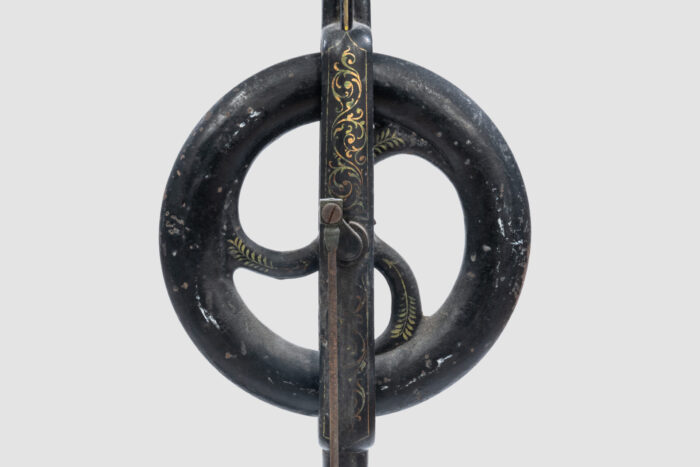
Treadle Drill Detail, Decorative Markings (Catalogue Number: 081)
However, despite its otherwise industrial appearance, the treadle drill in our collection also features several decorative markings. A variety of leaves and stems have been hand-painted on the machine, most clearly seen on the three pieces inside the wheel and the lower portion of the post. Despite the damage to this piece, based on the faint markings and comparisons to other surviving treadle drills, it seems that these decorative elements would have originally covered the circumference of the wheel and extended up the full length of the post. This shows attention was being paid not only to how dental tools functioned but also to their aesthetics - a reminder that, even in practical equipment like this, artistry and craftsmanship can be seen.
Our treadle drill, then, is not only an example of important improvements in dentistry, making treatments quicker and less painful for patients, but also a reminder that care was taken to make sure these tools did not just work well, but looked good too.