
Non-arcon Dental Articulator and Complete Set of Dentures
Non-arcon Dental Articulator and Complete Set of Dentures
Catalogue No. 078
by Lujain Hamdan
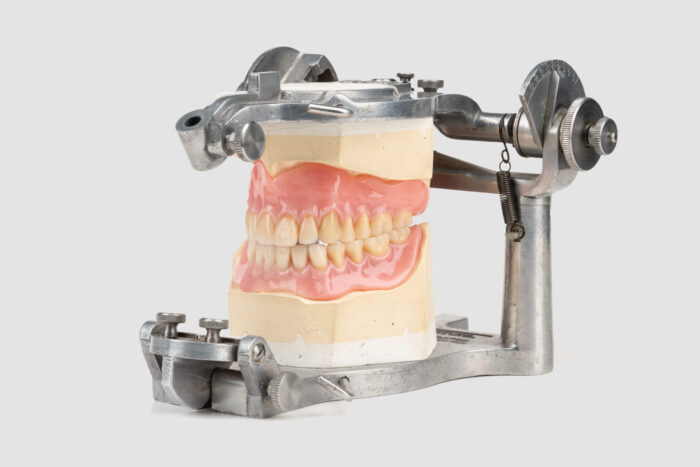
Non-arcon Dental Articulator and Complete Set of Dentures (Catalogue Number: 078)
When we think of dentistry, we usually picture it as a straightforward medical field focused on teeth, gums, and oral health. But there is more to it than just biology and disease. Behind every bite, chew, and smile is a fascinating science of movement, the way muscles, bones, and joints work together in a well-rehearsed choreography. This hidden side of dentistry, called biomechanics, helps explain how our jaws move and function every day.
The movements of the jaw are far too complex to be described as just a hinge that opens and closes. Instead, it glides, rotates, translates, and adapts. The temporomandibular joint (TMJ), which connects the lower jaw (mandible) to the skull, allows this wide range of motion. As a result, prosthodontic work (like creating dentures or crowns) has traditionally relied on estimates and averages, rather than perfectly precise measurements.
To help overcome this challenge, articulators (mechanical stand-ins for the skull and its movements) were developed. Early articulators could only mimic basic hinge motions, overlooking the subtlety and complexity of the jaw’s muscular harmony. As our understanding of biomechanics grew, so did our ambition to replicate, rather than simply approximate, natural jaw movement. A major breakthrough came with the introduction of semi-adjustable articulators, marking a pivotal moment for both restorative dentistry and prosthodontics.
Since then, our understanding of physics and jaw dynamics has transformed prosthodontics into a more dynamic field. Movements of the jaw were no longer considered abstract ideas, but as measurable and recordable phenomena, acknowledging the skull and jaw as a precise mechanical system with real clinical importance. Angles mattered. Axes mattered. Velocity, force, and torque all began to speak through adjustable pins and calibrated pathways.
Training to place a crown, fit a denture, or install a bridge was no longer seen as a flat, two-dimensional process - it became a truly three-dimensional practice. The semi-adjustable articulator brought physics out of the textbook and into the hands-on world of wax, acrylic resin, and porcelain. Here, theory met practice, as the sciences of motion and mechanics came together with complex biological and pathological realities of the mouth.
The item in our collection comprises a wax try-in denture mounted on a semi-adjustable articulator.
These articulators provide a more accurate simulation of the anatomical movements of the TMJ than earlier models. Earlier, simpler articulators treated the jaw as if it opened on a simple hinge. But the human jaw is more complex: full mouth opening happens in two stages: rotation, and translation. Stage one is rotation, where the joint acts as a hinge opening the mouth up to 20-25mm. Stage two of the mouth opening is called translation, where the mandible slides forward and downward instead of simulating a hinge movement, opening the mouth further than 25mm.
To address this complexity, the mean-value articulator was developed. This type of articulator is based on average values of the anatomical structures in the TMJ movement across the population (such as the condylar guidance angle, Bennett angle, and incisal angle). While this was a step forward, it did not account for individual variation. While the mean-value articulator respects the complexity in the movement, it doesn’t consider the anatomical variations between different patients. Dr. Alfred Gysi introduced the semi-adjustable articulator in the early 1900s, hoping to overcome the shortcomings of previous articulators.
The example in our collection is a non-arcon semi-adjustable articulator. In this type of device, the “jaw joint” parts (called condylar elements) are attached to the top section, while the guiding surfaces (called condylar guidance) are part of the bottom section. Although the real anatomy of the TMJ is the other way around, the non-arcon semi-adjustable articulator was closer to precisely mimicking the movements of the TMJ than other previously used articulators.
This kind of articulator can be adjusted in many ways to match an individual patient’s jaw movements, including the angles of the jaw joints, how the jaw moves sideways, the distance between the joints, the path the jaw follows when opening and closing, and how the front teeth guide the bite. These measurements of the articulator are customized to each patient’s jaw movements, taking some of the uniqueness of patients’ anatomy into consideration. This is done by using a “facebow”, as it aids in recording the spatial relationship to the TMJ and the base of the skull during movements of the jaw.
The semi-adjustable articulator has been recognized for its high accuracy in capturing and allowing the replication of the TMJ movements. This improved the accuracy of prosthodontic treatments, leading to longer-lasting restorations, more stable and retentive dentures, and improved patient comfort. It also allowed dentists to treat more complex cases where TMJ disorders and asymmetry is found, to overcome the idea of standardized fabrication methods.
When it comes to prosthesis, the semi-adjustable articulator, literally and figuratively, drew a path to success in treatments. This articulator facilitated a more accurate fit of crowns and bridges, reduced the need for adjustments, and produced better occlusal relationships. When it comes to dentures, the more precise capture of measures aided in producing dentures that are more retentive and stable, which optimized the patients’ comfort allowing them to adhere to wearing their new dentures.
Adding to that, when it came to aesthetics, using a semi-adjustable articulator provided better direction for the dentist when planning the treatment, as understanding the jaw movements influences the choice of aesthetics in a way that enhances the facial harmony of the patient. Not only that, but understanding the scope of the sophisticated movements, to an extent, facilitates full-mouth rehabilitation treatments, where complex reconstructions become less intricate, and with better treatment outcomes.
However, the semi-adjustable articulator’s role wasn’t constricted to only prosthesis, as it also plays a crucial role in diagnosis. Because it can replicate the jaw’s movement, the semi-adjustable articulator allows more accurate comprehension of the oral dynamics, aiding in the identification of any interferences in the movements and their paths that can cause TMJ disorders and dysfunctions.
While the semi-adjustable articulator represented a major advance, it still relies on some average values, especially for the condylar guidance path and hinge axis location. Conditions such as TMJ degeneration, disc displacement, inflammation, and bruxism can all affect jaw movements and anatomy in ways that semi-adjustable models cannot fully replicate. For cases requiring the highest precision, fully adjustable articulators were developed. These articulators allowed dentists to record the condylar guidance’s path individually during protrusive and lateral movements, providing superior, more intricate details for each patient.
Nevertheless, and although fully-adjustable articulators provide superior precision, the semi-adjustable articulators remain the most used in dental clinics to this day. This is due to their practicality and ease of use, and because of the time efficiency they provide, as it still delivers reliable results in most clinical cases.