
A Licence to Drill: Investigating a Victorian Dental Certificate
A Licence to Drill: Investigating a Victorian Dental Certificate
by Meghan Mills-Amissah
This blog post examines the historical significance of a Dental Registration Certificate from 1879, issued shortly after the UK introduced formal regulation of dentistry. It reveals how such documents marked a shift toward professional standards and public trust in medical qualifications.
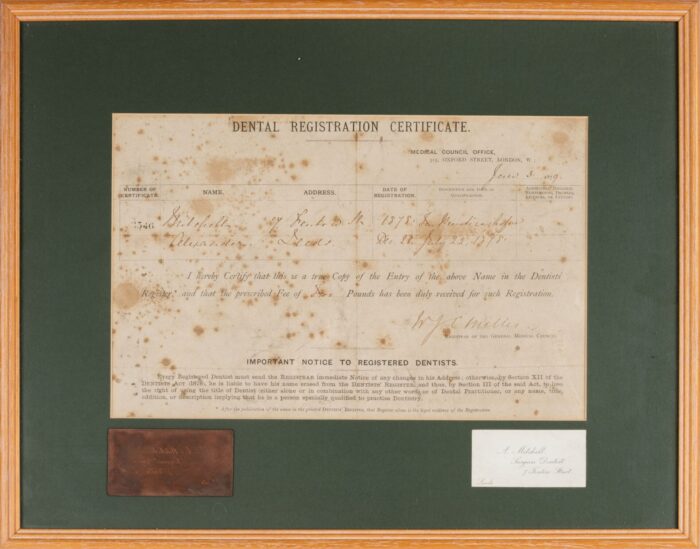
Dental Registration Certificate (Catalogue Number: 083)
Framed on a dark green mount, browned with age and speckled with foxing, a modest sheet of paper quietly marks a turning point in the history of British dentistry. The document is a Dental Registration Certificate, issued on 3 June 1879 to an individual named Alexander Mitchell. His address is listed as 17 Easton Road, Leeds, and the certificate confirms he was officially registered to practise dentistry in the United Kingdom. It was signed by W J Smith, a member of the General Medical Council, the body still responsible for regulating medical professionals in the UK today. On the surface, this certificate might appear to be just another bureaucratic formality. But look a little closer and it opens a window into a time of transformation, not just for Mitchell but for the entire dental profession.
Before the late nineteenth century, dentistry in Britain was largely unregulated, allowing individuals to be called a dentist without formal training or qualifications. Many early dental practitioners were barbers, blacksmiths or travelling tradesmen who learned by observation or sheer trial and error. That changed with the Dentists Act of 1878, the first law to introduce official registration for dental practitioners in the UK. This created the Dentists Register, a public list of qualified individuals legally recognised to practise dentistry. For the first time, there was a clear boundary between trained professionals and unlicensed operators. To be included in the register, practitioners had to hold a recognised qualification, such as the Licentiate in Dental Surgery (LDS) awarded by the Royal College of Surgeons of England, a credential that Alexander Mitchell possessed.
Mitchell’s certificate was issued just one year after the new law came into effect, making him part of the first wave of dentists to formalise their status under the new regulations. His entry records two dates December 28 and July 22 1878, possibly indicating when he qualified and when his details were added to the register.
The wording is formal but significant:
I hereby certify that this is a true Copy of the Entry of the above Name in the Dentists' Register, and that the prescribed Fee of Two Pounds has been duly received.
That two-pound fee, equivalent to approximately £200 today, was not just payment for paperwork. It was an investment in credibility. For patients, a framed certificate like this in a waiting room reassured them that their dentist had been trained and vetted. For the dentist, it was proof of hard work and professional status, and a defence against legal challenges.
The 1878 Act did not immediately end unlicensed practice. It allowed existing practitioners to register even if they had no formal qualification, provided they could prove they had been practising before 1878. But for younger dentists like Mitchell, qualifications were increasingly the norm. Institutions like Royal Dental Hospital of London and the University of Edinburgh Dental School began training new professionals. Journals, dental societies and public health initiatives helped to further formalise the field, including the establishment of the Leeds Dental Institute. Over time, dentistry evolved from a trade into a recognised branch of medical science.
This certificate is a valuable reminder of the often-overlooked history of professional regulation and how it shapes not just careers but public trust. Today, it could be taken for granted that doctors and dentists must be trained and licensed. In the late 1800s, this was still a radical idea. The fact that Mitchell’s certificate remains framed and preserved suggests it meant more than just permission to practise - it was a milestone. A symbol of his entry into a modernising profession at a time when standards were being raised across the medical world.
Though we know little about Alexander Mitchell beyond this certificate, his inclusion in the official register places him among the pioneers of regulated dentistry in Britain. The framed document tells us that someone, perhaps family, a collector, of Leeds Dental Institute, recognised its significance and chose to keep it safe. For all its formal language and faded ink, it is a simple object, but one that connects us to a bigger story of education, reform and the slow but steady rise of professional standards in public health.