
A Killer Smile: The Vulcanite Patent Wars
A Killer Smile: The Vulcanite Patent Wars
by Rae Gillibrand
When you think of the darker side of dental history, you probably imagine quack remedies, transient tooth-pullers, or the infamous ‘Waterloo Teeth’. However, in the mid-nineteenth century, dentistry was the scene of a bitter (and bizarre!) patent dispute that led to lawsuits, espionage, murder, and even a foiled prison escape involving a peach…
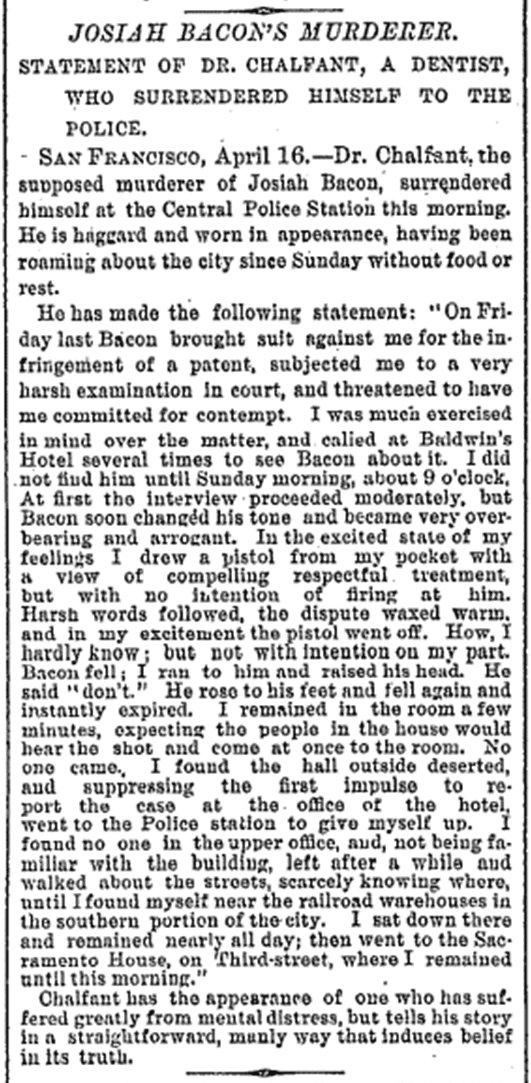
The New York Times, April 24, 1879
It all began with vulcanite, a revolutionary material invented by Charles Goodyear in 1843. Hard yet slightly flexible, this form of vulcanized rubber was cheap to produce and comfortable to wear. For the first time, artificial teeth became affordable for ordinary people, not just the wealthy.
By the 1860s, the U.S. patent for making dentures from vulcanite was in the hands of Josiah Bacon, a shrewd and ruthless businessman at the helm of the Goodyear Dental Vulcanite Company. Determined to extract as much profit as possible, Bacon demanded that dentists pay him an annual licence fee of approximately $100 at the time (nearly $1,900 or £1410 today). Many dentists ignored him, continuing to supply affordable dentures without paying his fees. But Bacon wouldn’t stand for that. He took countless dentists to court and even employed female ‘spies’ to visit dentists and catch anyone who was violating the patent.
By 1879, Bacon was in San Francisco with a list of dentists he intended to take to court. Among them was Dr. Samuel P. Chalfant, a dentist who Bacon had already attempted to sue twice before. Chalfant visited Bacon’s hotel room, hoping to negotiate, but the discussion quickly turned sour. Accounts vary, but Chalfant claimed that in the heat of the argument his pistol ‘accidentally’ discharged, shooting Bacon in the abdomen. Bacon died of his wounds, and Chalfant fled the scene before surrendering three days later. Convicted of second-degree murder, he was sentenced to ten years at San Quentin prison, where served as the prison dentist.
Four years into his sentence, Chalfant tried to escape. Dressed in civilian clothes and disguised with a fake beard and moustache, he walked out of the prison unchallenged and boarded a train. But his plan was undone by a peach! The juice loosened the glue on his false beard, catching the eye of a suspicious railroad detective. He was returned to prison, where he served another three years before he was released.
Bacon’s death brought an end to the Goodyear Dental Vulcanite Company’s aggressive patent enforcement. The company stopped collecting fees after the murder and let the patent lapse in 1881.
Vulcanite dentures crossed the Atlantic soon after Goodyear’s invention and were just as popular in Britain as in America. By the 1850s, British dentists were adopting the material widely. It offered a lighter, more comfortable, and far cheaper alternative to ivory, porcelain, and human teeth often used in earlier dentures. Unlike in the United States, however, the British dental profession was not entangled in costly licensing battles. As a result, vulcanite dentures became a standard part of dental practice in Britain throughout the latter half of the nineteenth and early-twentieth centuries.
Want to see some vulcanite dentures for yourself? We have some in our collection in the Worsley Building - please get in touch via our ‘contact us’ form for more information. You can also see our Casco Vulcaniser (a device used for creating vulcanite dentures) in our digital catalogue, here!